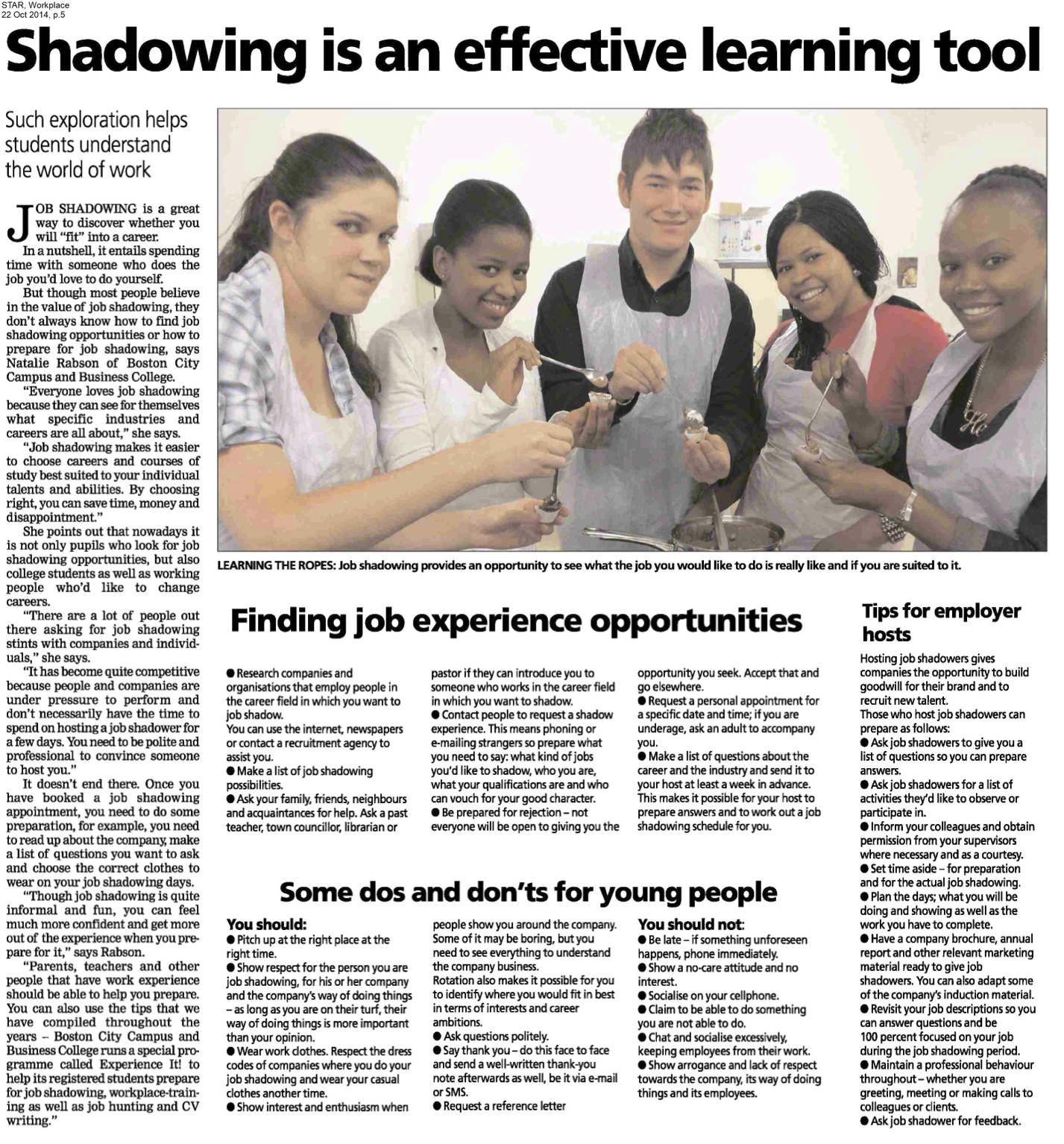
Job shadowing is a great way to discover whether you will ‘fit’ in a career. In a nutshell, it entails spending some time with someone who does the job you’d love to do yourself! But though most people believe in the value of job shadowing, they don’t always know how to find job shadowing opportunities or how to prepare for job shadowing, says Natalie Rabson of Boston City Campus & Business College.
“Everyone loves job shadowing because they can see for themselves what specific industries and careers are all about,” she comments. “Job shadowing makes it easier to choose careers and courses of study that are best suited to your individual talents and abilities. By choosing right, you can save time, money and disappointment.”
She points out that nowadays it is not only school learners that look for job shadowing opportunities, but also college students as well as working people who’d like to change careers. “There are quite a lot of people out there asking for job shadowing stints with companies and individuals,” she says. “It has become quite competitive because people and companies are under pressure to perform and don’t necessarily have the time to spend on hosting a job shadower for a few days. You need to be polite and professional to convince someone to host you.”
It doesn’t end there. Once you have booked a job shadowing appointment, you need to do some preparation, for example, you need to read up about the company, make a list of questions that you want to ask and choose the correct clothes to wear on your job shadowing days. “Though job shadowing is quite informal and fun, you can feel much more confident and get more out of the experience when you prepare for it,” says Rabson. “Parents, teachers and other people that have work experience should be able to help you prepare. You can also use the tips that we have compiled throughout the years - Boston City Campus & Business College runs a special programme called Experience It! to help its registered students prepare for job shadowing, workplace-training as well as job hunting and CV writing.”
Finding job shadowing opportunities
Research companies and organizations that employ people in the career field you want to shadow. You can use the Internet, newspapers or contact a recruitment agency to assist you.
Make a list of job shadowing possibilities.
Ask your family, friends, neighbours, acquaintances, teacher, town councillor, librarian or pastor if they can introduce you to someone who works in the career field you want to shadow.
Contact people to request a shadow experience. This means phoning or emailing strangers so prepare what you need to say: what kind of jobs you’d like to shadow, who you are, what your qualifications are, and who can vouch for your good character. Be prepared for rejection – not everyone will be open to giving you the opportunity you seek.
Request a personal appointment for a specific date and time; if you are under-age, ask an adult to accompany you.
Make a list of questions about the career and the industry and send it to your host at least a week in advance. This makes it possible for your host to prepare answers and to work out a job shadowing tour/schedule for you.
Must-dos when job shadowing
Pitch up at the right place at the right time.
Show respect for the person you are job shadowing, for his/her company and the company’s way of doing things – as long as you are on their turf, their way of doing things is more important than your opinion.
Wear work clothes. Respect the dress codes of companies where you do your job shadowing and wear your ‘chill’ clothes another time.
Show interest and enthusiasm when people show you around the company. Some of it may be boring, but you need to see everything so you can understand the company business. Rotation also makes it possible for you to identify where you would fit best in terms of interests and career ambitions.
Ask questions in a polite manner.
Say thank you – do this face to face and send a well-written thank you note afterwards as well, be it via email or sms.
Request a letter of reference, or letter confirming the job-shadow experience and hours. This will come in use for your CV and your LO portfolio.
Things to avoid while job shadowing
Being late - if something unforeseen happens, phone immediately.
Showing a no-care attitude and no interest.
Socialising on your cell phone.
Claiming to be able to do something you are not able to do.
Chatting and socialising excessively, and keeping employees from doing their work.
Showing arrogance and lack of respect towards the company, its way of doing things, and its employees.
Tips for job-shadowing hosts Hosting job shadowers gives companies the opportunity to build goodwill for their brand and to recruit new talent. Those who host job shadowers can prepare as follows:
Ask job shadowers to give you a list of questions so you can prepare answers in advance.
Ask job shadowers for list of activities they’d like to observe or participate.
Inform your colleagues and obtain permission from your supervisors where necessary and as a courtesy.
Set time aside – for preparation and for the actual job shadowing.
Plan the job shadowing days; what you will be doing and showing as well as the work you have to complete.
Have a company brochure, annual report and other relevant marketing material ready to give job shadowers. You can also adapt some of the company’s induction material.
Revisit your job description so you can answer questions and be 100% focussed on your job during the job shadowing period.
Maintain a professional behaviour throughout – whether you are greeting, meeting or making calls to colleagues and/or clients.
Students that apply for admission at Boston City Campus & Business College will get a response to their applications within two working days. And those that apply long in advance for their 2016 studie…
Read more »